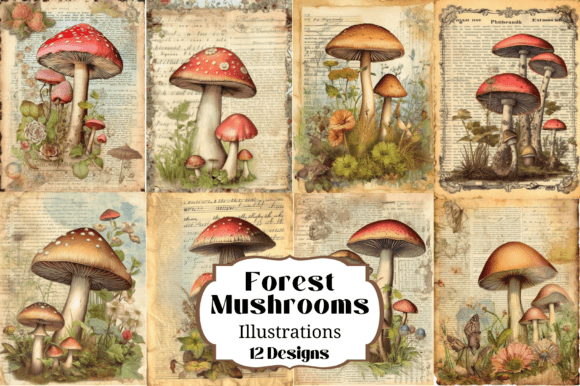
Woodland Forest Mushroom JJ Backgrounds for Junk Journals
Capturing the Whimsy of the Forest Floor
There is a specific kind of magic found in the quiet corners of a forest—where moss clings to stone and fungi push through the damp earth in vibrant clusters. Woodland Forest Mushroom JJ Backgrounds capture this organic, slightly mysterious aesthetic perfectly. If you are a crafter, designer, or content creator looking for that earthy, grounded vibe, these digital papers offer a solution that feels both authentic and versatile. This collection features twelve distinct illustrations designed to mimic the textures and tones of the deep woods.
The visual personality of this set is undeniably rooted in nature, but it carries a stylistic flair that goes beyond a simple photograph. You will find a mix of rich, saturated colors—think deep burgundies, olive greens, and slate blues—blended with intricate line work that suggests vintage botanical prints. The illustrations range from dense clusters of toadstools and chanterelles to single, majestic fly agaric mushrooms standing alone against textured backdrops. Some backgrounds feature a scattered pattern, while others offer a more focused composition. The "JJ" in the title signifies its primary application: Junk Journals. This implies a texture that feels tactile, perhaps mimicking old parchment or distressed paper, making them ideal for layering.
Unlike a generic stock photo, these backgrounds have a distinct artistic voice. They aren't just flat images; they possess a depth that allows them to serve as a foundation for other design elements. Whether you are building a page in a handmade book or designing a social media post for a cottage-core brand, the visual weight of these mushrooms provides an immediate focal point. They bridge the gap between digital precision and handcrafted imperfection, offering a creative font of visual inspiration for your projects.
Practical Applications for Designers and Crafters
The utility of the Woodland Forest Mushroom JJ Backgrounds extends far beyond simple scrapbooking. For graphic designers and brand strategists, these assets are a goldmine for specific niches. If you are working on packaging design for a botanical soap company, an artisan tea brand, or a local organic market, these textures add an immediate sense of authenticity. They work exceptionally well as background layers for product labels, where you can overlay clean typography—perhaps a crisp sans serif font—to ensure legibility while letting the mushroom illustration peek through.
In the realm of editorial design and publishing, the collection shines. Imagine using these as chapter dividers in a self-published book about herbalism or fantasy fiction. The atmospheric nature of the illustrations helps set the mood without requiring extensive illustration commissions. For web design, these backgrounds can be tiled or used as hero section images for blogs focused on hiking, foraging, or sustainable living. Because they are high-resolution PNGs, you can resize them without losing quality, ensuring they look sharp on high-DPI screens.
For the hobbyist and small business owner, the applications are just as practical:
- Junk Journaling & Scrapbooking: Use them as full-page backgrounds or cut out individual mushroom clusters to create dimensional layers.
- Card Making: Resize the images to fit A2 or A6 card bases for unique greeting cards suitable for autumn or "thinking of you" themes.
- Social Media Graphics: Create cohesive Instagram stories or Pinterest pins for content creators in the nature or cottage-core space.
- Printables: Design wall art or planner stickers that feature these intricate fungal motifs.
It is worth noting that these are digital assets intended for integration into your own work. They function much like a premium font or a high-quality texture pack—tools that elevate your output rather than defining it entirely. They provide the "canvas" upon which you can apply your own typography, such as a script font for wedding invitations or a bold serif font for magazine headers.
Integrating Texture into Your Brand Identity
When we talk about brand identity, we often focus on logos and color palettes. However, background textures play a crucial role in the "feel" of a brand. Using the Woodland Forest Mushroom JJ Backgrounds consistently across your marketing materials can help build a recognizable visual language. If your brand personality is earthy, whimsical, or slightly vintage, these illustrations support that narrative effectively.
Consider how these backgrounds influence visual hierarchy. Because the mushroom illustrations are detailed, they demand a certain type of foreground element to maintain readability. This is where modern typography principles come into play. You would likely want to pair these backgrounds with a clean, bold typeface. A heavy display font with a solid fill or a drop shadow can cut through the complexity of the background, ensuring your message isn't lost in the foliage. Conversely, if you are using the backgrounds for a watermark or a subtle branding element, a lighter, more ethereal handwritten font might complement the organic shapes of the mushrooms.
Here are a few design observations for working with these assets:
- Contrast is Key: Since the backgrounds often feature dark or mid-tone colors, white or cream-colored text usually offers the best legibility.
- Opacity Adjustments: Don't be afraid to lower the opacity of the background image. This allows you to "knock back" the texture, creating a more subtle surface for text-heavy designs like menus or brochures.
- Cropping: The value of these assets increases when you stop viewing them as whole images. Cropping in on a specific cluster of chanterelles or a single red cap can create entirely new compositions.
Technical Details and Usage Rights
Understanding the file specifications is essential for a smooth workflow. The collection includes 12 separate images delivered in a single zip file. The format is PNG, which is critical for crafters and designers. Unlike JPEGs, PNGs support transparency (though these backgrounds are likely full-bleed) and, more importantly, they do not compress the image data in the same lossy way, preserving the fine details of the mushroom textures. The files are labeled clearly, so you aren't guessing which pattern is which when you are in the middle of a creative flow.
A significant advantage highlighted in the product description is that the digital files are much larger than the samples shown. This is a common point of confusion in digital downloads. Preview images are often compressed for fast web loading, but the actual files you download are high-resolution. This means you can print these backgrounds at large scales—perfect for poster prints or large scrapbook layouts—without encountering pixelation or blurriness.
Regarding licensing and usage, the terms are standard for design assets but important to respect. These files are for your use in your projects. You may not resell the digital files themselves as a standalone product (e.g., bundling them into your own digital paper pack to sell on Etsy). Similarly, you may not claim to be the artist of the original illustration. However, you are free to use them in physical or digital end-products for sale, such as a finished journal, a printed poster, or a logo design for a client. This makes them a valuable asset for small business owners who need high-quality visuals without the copyright headaches of stock photo sites.
Ultimately, the Woodland Forest Mushroom JJ Backgrounds offer a blend of artistic charm and practical utility. They serve as a reminder that great design often starts with a strong foundation—and in this case, that foundation is rooted firmly in the forest floor.